
The Sportsman Golf Course receives a “B2” grade on the Albatrace Track Index. Read the article below to find out why, and let us know if you agree or disagree in the comments!
Far down in the southwestern corner of the Hoosier State, where the forested hilltops and creek valleys cascade into the Ohio, you’ll find a quiet, almost-heavenly slice of countryside called Switzerland County. Here among the ridges, gravel roads, cut-and-fill ponds and the cattle grazing on their banks, the landscape can feel like a cross between Appalachia and Alpine. If you, like me, find rest in these rugged sort of places, this hidden enclave of the Midwest will captivate and comfort your soul.
It was inevitable, then, that after stumbling across The Sportsman Golf Course on a misty morning’s drive, high into the backcountry, it would take up a permanent residence in my mind. I was on my way to another place, only a few miles down the hill but seemingly in an entirely different world; rounding the corner on Indiana 250, it was the stripes of a fairway mower that first caught my attention. Then, a black-and-white checkered flag; then another, and another. Lost in fascination, I may have nearly veered off the road.
I couldn’t stop thinking about it; for a moment, I considered abandoning my tee time at the casino course down by the river, turning back and diving headfirst into the adventure. With some amount of cowardice, I chose not to, but I vowed to myself that I would soon return and explore the alluring gem I had just discovered.

the soul:
On the day of my eventual visit, there was hardly anyone else on-site, which gave me ample time to inspect the property, photograph my favorite spots, and enjoy the course at a gentle pace. At the turn, I stopped in the clubhouse to ask the woman at the front desk what the story was behind The Sportsman; taken by surprise at first, she would soon reveal that the course began as a nine-hole track in the 1970s, mostly built by a group of locals. Then, sometime in the late ’80s or early ’90s, her husband and father-in-law began construction of a second nine, as well as the large lake at the south end of the property.
At that time, the course was known as The Vineyard; from what little research I’ve been able to accomplish, conditions began to deteriorate in the early 2020s. Eventually, the course was purchased by a new ownership group, “The Sportsman LLC”, in early 2023.

Like all good backcountry golf courses, this one has a gravel parking lot, dually servicing both the clubhouse and maintenance facility. It’s right off the road; there’s no carefully-planned entryway, weaving around the landscape until you get just the right reveal. The Sportsman is no-frills at its finest – if you want to play golf, well, here you are.
In similar fashion, the clubhouse is understated; I wouldn’t classify any of this as intentional atmosphere-building, but it doesn’t feel like the place is trying to be anything that it’s not. It’s an old building sandwiched up against a newer one, and the interior is exactly what you think it might be – somewhat dimly-lit, fairly empty and ever-so-slightly seasoned with the aroma of cigarette smoke. Not necessarily a place I’d want to spend much time, but I’m sure the locals do, and that’s exactly what makes this feel like more of a community space than a real “pro shop”. I love it.
Once you get out on the course, this humble-yet-homeful sentiment is sustained; the cartpaths and conditioning are definitely more on the ragged side, but in a charming sort of way. Down by the big lake on the back nine, a small fishing pier and a couple of upturned canoes are further evidence that this isn’t your traditional, tight-collared country club. I can only imagine the fond memories that exist down there by the water on a warm summer’s afternoon, casting a line and listening to the crickets chirp.
This isn’t the curated kind of “soul” that you’d find at the most elite level, but to me, The Sportsman Golf Course feels like a place where real people do life together. For the few hours that I spent on property, I was almost convinced that I could have been an equal part of that. In light of these considerations, we’re going to give The Sportsman a “2” on the Soul scale of the Albatrace Track Index – not fully intentional, but fully present, and entirely unforgettable.
THE SUBSTANCE:

This is the part where we enter more golf-course-architecture-snob territory, which feels somewhat contradictory to the information shared under the previous heading of this article. Nevertheless, The Sportsman Golf Course is the artistic work of several pairs of hands; an expression of the way these few individuals thought golf should be played across this parcel of Midwestern landscape. Thus, it must undergo the same kind of scrutiny as any other golf course would see, were it featured here.
I’m a nerd; what can I say?
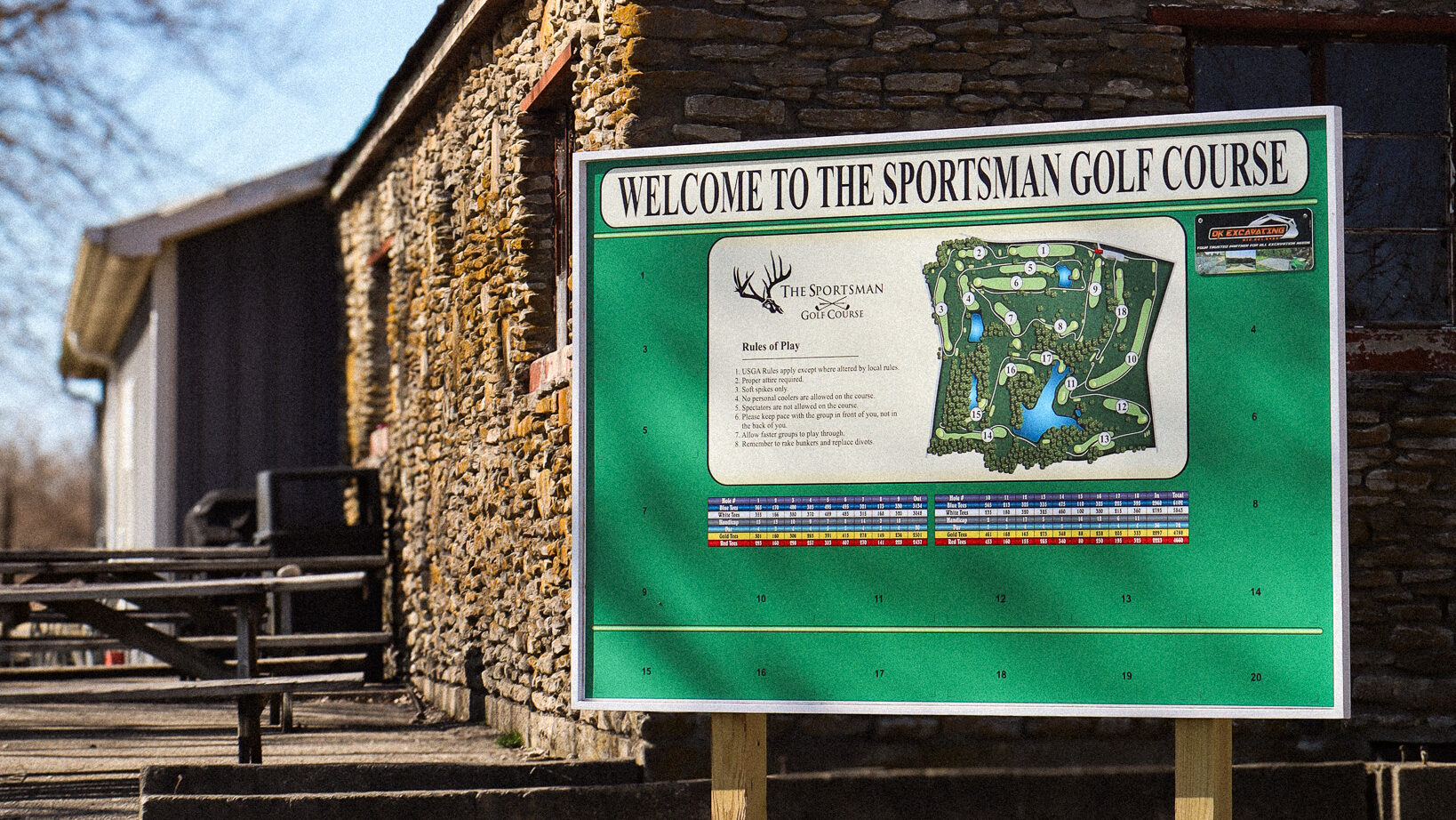
From a grand perspective, the routing is a noteworthy topic; as you might see in the map shown above, the front nine is a bit compact, and considerably more open when compared to the latter half of the course. Hopefully, you’ll remember that these are also the original nine holes at The Sportsman – the adventurous back nine, added later, features much more dramatic terrain, and a few unorthodox hole designs. As such, there seems to be a lack of cohesion to the routing, and in retrospect it can feel like the golfer is playing two different nine-hole courses, to some degree.


a view of the more spacious front nine, with the fourth green in the foreground, and the par-four third extending beyond.
the narrow chute between trees and the dramatic topography of the par-five fourteenth.
Still, the routing is not ill-conceived; like any good story, things get off to a relatively slow start, but the front nine establishes a firm foundation and gives the player a moderated preview of what they can expect after making the turn. The stretch from 10-13 is a bit like the rising action, showing off the grand vistas of the lower lake while keeping things out in the open on the eastern side of the property. Finally, the reveal at the tee of the par-five 14th – and again at the crest of the hill in the fairway – fully immerses the player into a wild closing stretch that features some of the more memorable golf shots you’ll find in the Cincinnati area.
As for the strategy of the individual holes, The Sportsman is fully reliant on the shape of the land and the presence of mature trees to provide challenge and interest. There is only one bunker on the entire golf course, adjacent to the ninth green, and it acts more like a safety net than a real thought-provoking hazard. Water comes into play on several occasions, especially down the final few holes; it’s less of a strategic or heroic consideration, though, as it is a penal obstruction that must be confronted face-on.
waypoints | holes to note:
hole 1: par 4, 345 yards

The Sportsman opens up with a fairly tame two-shotter, but not a completely bland one: the fairway at the first is bisected by a valley that is roughly ten feet in depth, and requires a nearly 240-yard carry to clear it. For shorter hitters especially, this must be negotiated, along with the presence of Indiana State Road 250 hugging the entire right-hand side of the hole, and a private residence just a few steps beyond the green. This hole bears remarkable similarity to the opening par-four at Napoleon, almost 200 miles away.
hole 4: par 4, 360 yards
The fourth is a shockingly difficult hole, almost to the point of being unfair; still, it bears the character of a golf course designed and built with rudimentary skill and equipment, and thus can be somewhat endearing.

From a teeing ground cut into the side of one ridge, your drive is played diagonally across a small hollow, requiring a carry of at least 200 yards to clear the narrow creek bed running along the valley floor. The fairway is very steeply pitched to the player’s left-hand side – as much as fifteen percent in some places – and can be very difficult to hold. Yes, that’s the landing area shown in the image above.
The green is angled from short-right to long-left, making it more receptive to shots from the higher right-hand side of the fairway, which is almost inaccessible. As such, the strategy – if there is any – to this drive-and-pitch par-four hole seems to be simply blasting your tee shot as far as possible, and hoping for a decent lie from which you can approach the green with a wedge.
While not necessarily a good hole, the fact that so little earth could have been moved in creating it makes it feel more natural, and a bit more interesting than a bad hole where lots of land had to be reshaped.
hole 8: par 3, 180 yards

Let’s start here: if it weren’t for my visit being in mid-March, I wouldn’t have been able to see much of the eighth green from the tee.
The photograph above is taken from behind and to the far right edge of the teeing area, providing as much of a view as one can possibly get of this little green, which juts out from the top of the ridgeline beyond another hollow. It bears some of the characteristics of a volcano template, except for the very left edge of the green pad, which is more blended into the landscape. There are no bunkers; the question is simple: how well can you elevate the ball, carry it a distance of at least 170 yards, and make it stop somewhere inside a roughly 3,000-square-foot circle on the top of the next hill over?
hole 11: par 3, 205 yards
This is another par-three played over or around intervening foliage; this time, though, the shot required is in excess of 200 yards, played to a narrow green benched into the side of a slope, with the waters of the course’s largest lake waiting below.


To make matters worse, the green is diagonally oriented and partially obscured by the same slope from which it has been carved. Only the front-right portion is visible from the tee; the best approach, from what I can gather, is to try to play the ball off the slope to the left, letting it funnel down onto the putting surface. At such a distance, this is obviously much easier said than done.
While the eleventh is clearly a very difficult hole, it’s actually one that I like, from an architectural standpoint. I think of it as something like an “inverse Redan”, where the kicker slope and the angle of the green work in contrast to each other. This, of course, is less conducive to playability, but I don’t think it goes so far as to be unfair; even still, does every hole have to be as fair and playable as possible? The harder the task, the more inspired the assailant ought to be, in an effort to improve their skill and hopefully conquer it.
I’ve talked (written) myself into it – the eleventh hole at The Sportsman may just be one of my favorite par-threes.
hole 13: par four, 305 yards

The thirteenth is another hole that isn’t necessarily marked by quality architecture, but more by the charm (if you can see it) of simply finding a way to get a golf course from one point to the next, regardless of the kind of topography you might find in your way.
For the longest and most daring players, this green is technically driveable, though it is perched atop a faraway hill, surrounded by thick trees and out-of-bounds. For mere mortals, a shot of 225 yards to the bottom of the valley will ideally find a narrow strip of fairway – and hopefully not the poorly-placed cart path, as seen in the image above.
Make no mistake: this is not a good golf hole, by any stretch of the imagination. Yet, on a course that was likely built with farm equipment, it stands out as somewhat of a unique indication of the simple methods by which The Sportsman must have been created.
hole 17: par 4, 245 yards
That’s not a mis-print. Yes, this is a downhill, straightaway par-four, measuring a mere 245 yards (really only about 230 if you go for the green). Once more, mature trees are a major impediment along your path, and a watery grave is waiting close by.


There’s really no other way of putting it: the seventeenth at The Sportsman is a strange golf hole. Even so, it is one of the most memorable holes – if not the single most – you’ll encounter during your round.
From high atop another ridge, the tee shot is blind, steeply downhill toward the large lake. Anything longer than 195 yards is wet; two stately trees stand at the edge of the water, forming a narrow kind of goalpost through which some players will be able to approach to the green. The fairway bends around to the left, circumventing a small inlet of the lake, and the green is set out on a small peninsula, guarded closely on three sides.
Trying to find this green in one shot, from more than 200 yards away, is a fool’s errand; still, it makes you wonder why the hole couldn’t be just a few yards shorter, and played as a par-three. My impression, considering the rest of the routing and the nature of the course’s construction, is that maybe an excessive level of importance was placed upon achieving a par of 72 for the eighteen holes, and the only way that could be accomplished was by shoehorning this convoluted little golf hole into a minimal amount of space.
Nevertheless, it goes without saying that the green site at the seventeenth is quite impressive, and its position in the sequencing of the course as a whole is impeccable. What the designers (maybe more accurately called “builders”) got wrong in the architecture of this individual golf hole, they certainly made up for in making the penultimate hole so momentous.

In consideration of each singular part and its contribution to the course as a whole, it’s hard to say that the “substance” of The Sportsman Golf Course isn’t promising, at least in some areas. There is an amount of intentionality present in the design that cannot be ignored; still, it’s clear that this course is more of a communal enterprise than a masterwork of design.
As such, it feels appropriate to grade The Sportsman at a level “B” on the Substance scale of the Albatrace Track Index; ultimately, this gives it a “B2” designation, which is entirely respectable. If you find yourself in the area, or if you’re looking for a fun, off-the-beaten-path place to visit for the first time, I wouldn’t steer you away from this little backwoods course in the Indiana hill country. Maybe we’ll see each other out there sometime!
Grace and peace!