
Inspired by recent conversations concerning my disproportionate criticism of a particular public golf course near my hometown, I thought it would be the perfect time to revive a series of content that I had initially launched late last year. This is “re-tracing”.
Each week, we’ll take a look at one golf hole (sometimes maybe a stretch of holes) from a golf course that I’ve played, and give it a thoughtful redesign. These might not always be the worst of golf holes – just those that I feel have the potential to be much better than what they currently are. If you follow me on Instagram (@albatracegolf), you can watch a short video summary of these thoughts and sketches; if you’re more interested in unnecessarily long-form composition, you’re in the right place.

the design, at present
It felt only appropriate that we renew this series with a look at one of my least favorite holes from my home course, Hueston Woods.
The par-five you see mapped out above is the second – formerly the eleventh, as the front and back nine were recently swapped. It is a brutally long hole, measuring nearly 580 yards from the furthest tee; it is also quite narrow, especially off the tee.
Here is a look at the formidable drive most players face – particularly scary when the foliage is so dense:

The hole is essentially unreachable in two, except for the longest hitters – with a strong tailwind, to boot. That’s not a major concern, but it does make this a very difficult way to start the round.
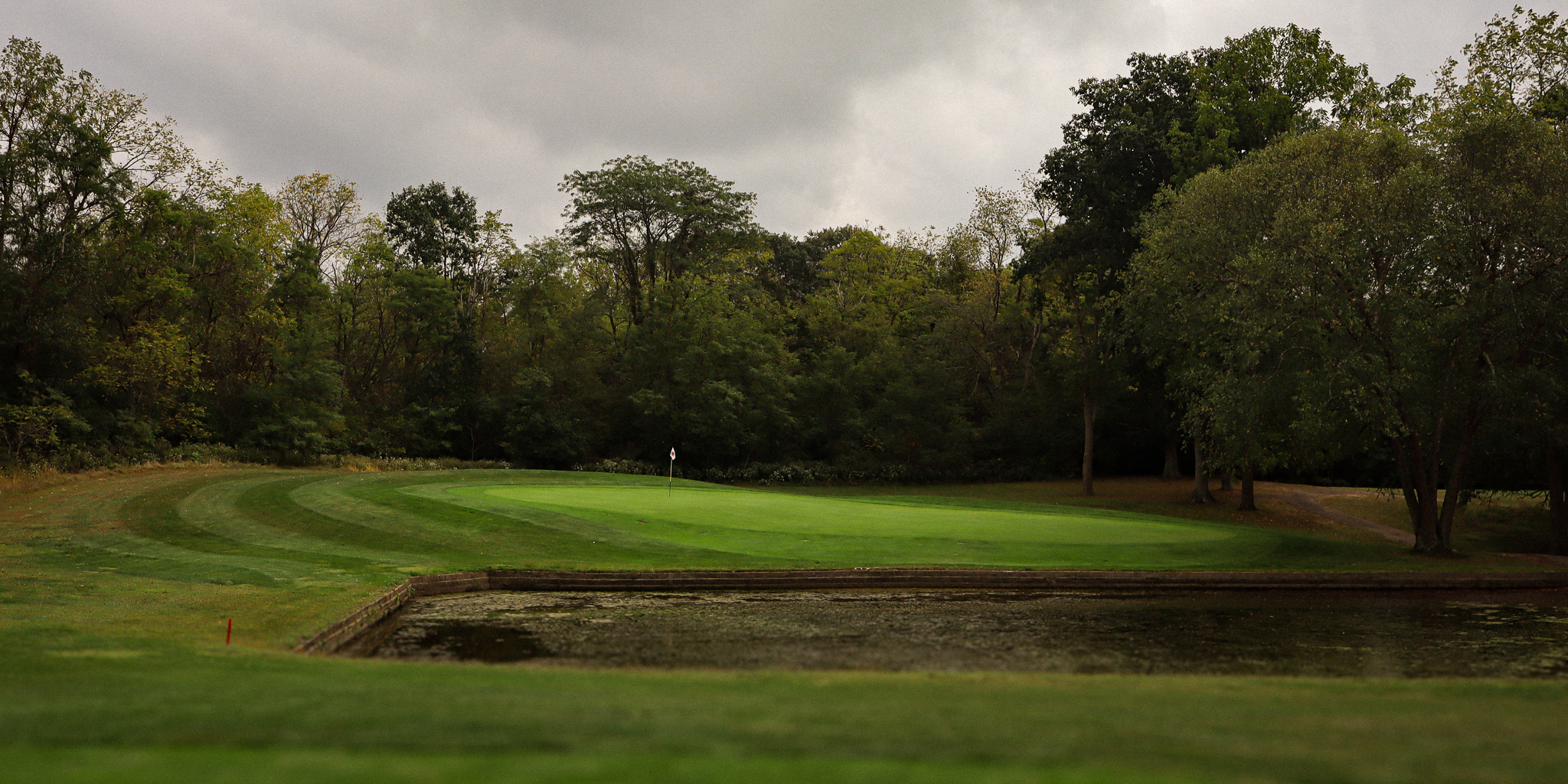
The primary issues here are in the overall narrowness of the hole; in particular, when it comes time for the player to “lay up” and position themselves for an approach into the green. Tall trees encroach on the ideal line of play, requiring the most careful placement in order to have an open look at the putting surface. Furthermore, a concrete-block, algae-covered pond sits just beyond the crest of a hill short of the green, and is blind to the player until they are nearly on top of it.


Considering these elements, even after a quality drive, anything less than the most accurate of lay-ups will result in – at best – an obstructed approach, or – at worst – a lost ball, and a nasty surprise.
For context, the small concrete-block pond is not a feature original to the golf course; as I have been told, it was created by one of Hueston Woods’ early superintendents. This is a classic example of nearsighted aesthetic appeal interfering with long-term shot values and ease of play. Sure, what was a small valley in front of this green – likely a difficult area to grow grass, considering the surrounding dense forest, lack of airflow and sunlight – probably seemed like an ideal place to add a small water hazard, marginally improving the appearance of this far corner of the property. But time has not been good to it; the block walls have begun to cave in, and it invariably reeks during the summer heat.
Not to mention the fact that first-timers have no idea it’s there, and often end up quite frustrated after a well-struck shot is followed by an unexpected “splash!”
the re-design, proposed
Given the chance to re-imagine this hole, I’d focus first on adding a bit of breathing room to either side of the playing corridor, and then make some key adjustments to the factors affecting the lay-up and approach shots.

You’ll note that I did, in fact, lengthen the hole with a new back tee (but there is a new forward tee also!); as previously mentioned, this being a true three-shot hole is not a concern to me. If anything, I’d like the longer hitters (principally those on the Miami University golf team) to be thinking more about that left-hand fairway bunker, and then have to make a calculated decision about how and where to position themselves for an approach.
Off the tee, the bunker in question has been adjusted slightly, more into the line of play than adjacent to it. I’ve also removed a few Black Walnut trees down the right, just to open things up a bit.
The primary changes, though, show up in the last 150 yards of this hole.


The stand of tall trees hugging the edge of the fairway short of the pond would be ripped out, and replaced with a single, intentional bunker. This trap would adorn the face of a low rise, ever-so-slightly impeding the player’s view of the fairway and putting surface beyond. It is positioned in such a way that players must effectively decide to lay back short of it, or attempt to carry it with a longer club, and a riskier shot.
Our delightful little concrete basin goes away as well, in lieu of a small drainage ditch (think Oakmont). What this accomplishes is threefold: it still protects the front of the green from players trying to get home in two; it still helps collect and move water away from a low-lying stretch of turf; and it occupies much less surface area than a pond, effectively decreasing the likelihood of a lost ball.
Finally, the green and its surrounds have been modified; the green is enlarged at back-right, with a small knob adding interest to the contouring of the right half. There is significantly more short grass around the green as well; we all know that this makes it easier to try a “Texas wedge”, but it also amplifies the consequences of a miss.


What I hope to have created here is still a challenging par-five, but one that is more easily and fairly navigated for the average player (as long as they are playing from the correct tee!).
Until next time,
Grace and peace!